Global warming… Fewer and fewer people doubt that it is a reality. This winter has been extremely harsh for many regions of the USA and Great Britain. At the same time Australia registered record heats in 2013, even implementing the violet color above the red one for temperatures exceeding 50°C. Something is happening to this planet through the new century. Data of the UN’s meteorological service shows that 2013 was the 6th warmest year since the beginning of meteorological statistics, i.e. for the past 160 years. Great Britain has gone through the 7 warmest and 4 wettest years for the past century and a half since 2000. Unusual phenomena can be observed in Bulgaria too. We are living through an extremely warm winter that has gunned down a series of temperature records. Who would imagine 10 years ago temperatures like 20°C and up in January and February? At the same time England and Japan were ice-frozen.
Even economy registers climate changes, says climate expert Georgi Stefanov from WWF, part of the Coalition for the Climate NGO.
“Insurance companies across the globe have raised their rates for damages, related to natural disasters several times. At the same time US companies of that kind refuse to offer their services over whole regions. For instance, the coastline of the Mexican Gulf that has been hit by powerful hurricanes many times over the past decade. I myself used to live in Florida in the period 2003 – 2005, during the strongest hurricanes. I survived the Katrina disaster right before my return. Things are really dramatic.”
Being a southern country, Bulgaria is amidst the most endangered ones.
Globally, climate changes are felt the least around the equator, where there is a large concentration of population. Their strongest manifestation is at the poles, but there are no people there. Bulgaria comes within the other parts of the planet that are affected the most by the negative impact of climate changes. Besides that, it is situated in the southern periphery of that zone.
“We have already registered a serious reduction in rainfall here – both in summer and winter. Farmers suffer this the most, along with all economy branches that involve the usage of water, for instance winter tourism. It is a subject of another discussion whether in this situation, with constantly rising temperatures Bulgaria should develop winter tourism that simply turns into something quite unprofitable. More sustainable forms of tourism would be more profitable. Unfortunately there are no serious assessments and analyses on the issue…”
Climate changes mean not only risks, but also an opportunity for a transfer to more stable economic models.
According to Mr. Stefanov the problem is not realized at all at this stage in Bulgaria. There are two possible reactions. The first one is prevention, i.e. reduction of the greenhouse effect via restrictions for carbon dioxide emissions. This country has recently adopted a delayed Law on Climate. However, the preparation of a national strategy for adaptation of all spheres of life to climate changes has been stalled for two years, though an interdepartmental working group has been created. “Bulgaria needs to develop a strategy, outlining adaptation measures for all economic spheres, water management, forestry, a sensible and careful usage of natural resources, adequate agriculture…” Mr. Stefanov says. “The lack of enough rainfall would mean that we won’t be able to grow crops and that we will have to turn to cotton, for instance, as it requires less water.”
Biodiversity will be the first victim of climate change.
“Unfortunately this is the least discussed aspect of the problem,” the WWF expert says. “Risks for biodiversity are highest, but the voice of wild nature can be barely heard in this debate. Numbers say it all: scientists say that 90 percent of biodiversity on this planet is endangered by climate change. Biological species will reduce drastically their populations or will disappear, if this trend is kept. This percentage is shocking enough for any further comments on details.”
One can observe already changes in the structure of species in this country. Plants and animals, typical for more southern geographic latitudes have started to penetrate. Others, typically Bulgarian, go to the North. “We need to act, if we don’t want to see our beautiful forests dry as the Greek ones. We need to restrict greenhouse gas emissions,” Mr. Stefanov warns. “It all depends on the personal behavior of each and everyone of us – we are or are not saving the planet, that’s it!” the expert says in conclusion.
English version: Zhivko Stanchev

The Bulgarian minority in Romania marked a significant event with the official opening of the Bulgarian Inn in the village of Izvoarele (Hanul Bilgarilor), Teleorman County (Southern Romania)- a locality with Bulgarian roots dating back over 200 years...

The 14th edition of DiVino.Taste, Bulgaria’s leading forum for wines and winemakers, will take place from 28 to 30 November at the Inter Expo Centre in Sofia. Over 80 producers from all wine regions will participate, offering tastings of around 600 of the..
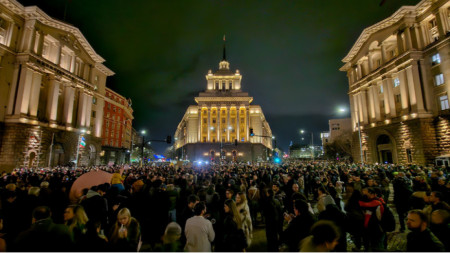
Minutes before the second and final reading, at the parliamentary budget and finance committee, of the state budget for 2026, the leader of the biggest party represented in parliament GERB Boyko Borissov halted the procedure and sent the draft bill..




 Scattered showers
 Rain
Rain Rain / Snow