If Bulgaria managed to become attractive to the global engineering industry, it could expect some serious interest from global manufacturers as well. This is what Xavier Richet, Professor at the Sorbonne, said during the international conference entitled "Economic Growth: Incentives and Constraints", held in Sofia. The Balkan region has become attractive to the global engineering sector. An example of this is the cooperation between Litex Motors and Chinese carmaker 'Great Wall'.
Professor Rositsa Rangelova from the Institute for Economic Studies with the Bulgarian Academy of Sciences told us more: "In recent years the financial literacy of Bulgarians has increased. People are much more careful when they borrow money from the bank. Unfortunately, investments made thanks to loans are directed towards sectors offering quick revenues such as trade and services, which do not bring growth. Investments in engineering or other strategic industries are rare."Currently, agriculture in this country is heavily dependent on EU funds and despite the potential and old glory of Bulgaria in the sector, about 90% of the fruit and vegetables are imported.
The period 2001-2008, before the start of the crisis, was very favorable for Bulgaria, given the low level of investments before that. The growth rate of the economy was not high, about 5.5 - 6% year-on-year. Foreign direct investments in 2007 reached 5 billion euro, keeping in mind that their volume in the 90's was very small. So far, so good, as they say.
If we looked at the structure of foreign investments related to gross domestic product (GDP) and to sectors of the economy, we see that 70-80% of them are in non-manufacturing sectors - financial services, real estate, trade, and others. They provide no added value and growth. This creates the illusion that Bulgaria used to attract big foreign investments and now it does not. During the crisis, the decline was significant and currently the level of foreign investments reaches 1-2% of GDP, or about 200 million euro.
Why do low taxes bring results in Ireland, for example, while the situation in Bulgaria is not the same?
"In Bulgaria the flat tax was suddenly introduced without any economic logic and it led just to an increase in the number of yachts and private planes," says Rositsa Rangelova.
A key condition for attracting investments is improving the business climate, i.e. providing stable economic and security policy. In Bulgaria governments change quickly and this creates uncertainty and investors do not know what to expect.
"The Irish have enough foresight not to change economic policy during the past 36 years, despite frequently changing governments. In Bulgaria each government denies economic policies of the previous one. If we managed to unite around a strategic vision, focused on the benefit of national economy and managed to follow it, we could hope for greater interest from global investors."
English: Alexander Markov
In its “Questions and Answers” section on the introduction of the euro, the Bulgarian National Bank has published a clarification on how the single currency should be denoted and written in accordance with EU regulations. The name of the..

The government approved the draft Law on the 2026 State Budget, as well as the Updated Medium-Term Budget Forecast for the 2026–2028 period. In connection with the introduction of the euro on January 1, 2026, all figures have been prepared in..
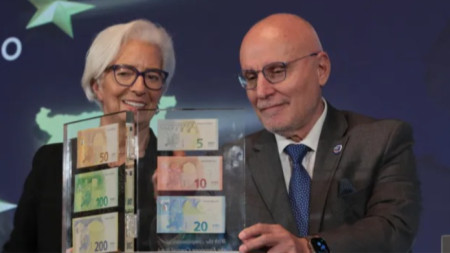
Citizens should remain calm about the introduction of the euro in Bulgaria from January 1, 2026, as the Bulgarian National Bank and commercial banks are ready for all processes related to the currency conversion and distribution of euro banknotes. This..






 Rain / Snow
 Rain
Rain Snow
Snow Значителна облачност със сняг