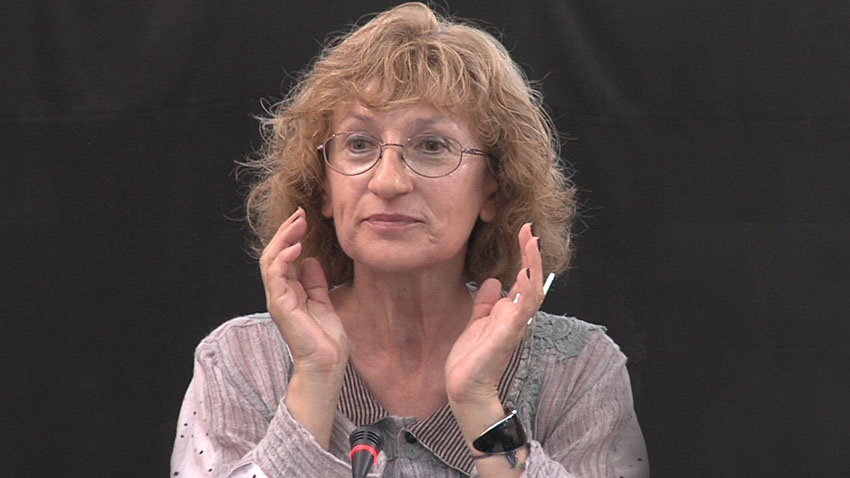
A discussion entitled River of Tolerance is taking place in Sofia on 6 February within the frameworks of the UN tolerance week. What challenges does tolerance face in our day and which of the latter-day problems hold good for Bulgaria?
Radio Bulgaria’s Maria Dimitrova-Pichot talks to Prof. Anna Krusteva from the New Bulgarian University’s Centre for Migration, Ethnic and Refugee Studies, one of the organizers of the forum.
“In this time of globalization when we are all living together with literally the whole world, when virtuality has brought everything within arm’s reach, we are seeing different forms of diversity all around us. How can one learn to live with other people, people of different religious denominations, values and way of life? A question that gives rise to endless discussion. We shall endeavour to outline just some of its aspects. Just a few days ago a debate was held on fanaticism and what a secular state can do to contain it. One of the participants put forth a thesis that Europe can regard itself as nothing but a Christian civilization and that Christianity is the only basis on which all differences can be reconciled. My colleagues and I upheld a different understanding of the European identity, an understanding that is more open to others. The question is how politics and culture can address these challenges. By way of dialogue, of inclusion, of throwing bridges a positive understanding can be attained of how to live together with others, something this forum is trying to throw into sharp relief.”
In the wake of the Charlie Hebdo tragedy, one question emerges very clearly – that of the need to talk these problems through. River of Tolerance has chosen an interesting angle.
“This round table is out to lay an emphasis on how the enormous challenge of living together can be talked though,” Prof Krusteva says. “What happened to Charlie Hebdo brought political reactions to a head, the discourse became hyper-politicized. We would like to place this discourse within a more positive genre and bring to the fore tolerance as part of dialogue. That is why we have invited prominent storytellers like the most widely read Bulgarian author Georgi Gospodinov and Alec Popov – a controversial but much-loved writer. Because art is a much more delicate instrument in the discourse on identity, on how the man in the street can live together with others, on the alchemy of inter-cultural communication.”
History teaches us to live together in understanding with people of different ethnic groups and different religions. It is no coincidence that it was Bulgaria that opened its doors wide to refugees from the Armenian genocide; it is no coincidence that it was Bulgarians that rescued their Jews from deportation even though the country was at the time ally to the Reich. But after years of isolation behind the Berlin wall, this new wave of refugees from Syria seems to have caught us off guard. So, is the traditional Bulgarian tolerance a myth?
“It is difficult to say whether in our day, Bulgarians are more tolerant or less tolerant,” Anna Krusteva says. “There are Bulgarians who opt for intolerance in its most extreme forms of xenophobia and racism and then there are others who opt for tolerance, solidarity, empathy. The refugee wave has put to the test the eternal question of just how tolerant Bulgarians are. We saw two diametrically opposed reactions. One was of fear which the people dealing in fear had no qualms in capitalizing on. The extremist parties instantly transformed this humanitarian issue into an imminent menace, referring to refugees not as people fleeing war but as potential terrorists, something there is not the slightest evidence of for the time being. At the other end, and I would like to lay an emphasis on this – absolutely spontaneously, with no organization whatsoever – there were numerous civic initiatives of solidarity, a great many human rights groups, young people with an enormous amount of energy in the social networks. In fact, during the first difficult year of the refugee wave they took the place of the state in the name of solidarity, of our shared responsibility of being together as much as a difficult situation requires.”
English version: Milena Daynova
Timișoara, a large multicultural city in western Romania, is the center of the historical community of the Banat Bulgarians . The members of this community are descendants of settlers from the Bulgarian lands nearly three centuries ago, who have..

In Gabrovo – a city in the geographical center of Bulgaria, once described as the Bulgarian Manchester, but today facing demographic challenges – there are young people who believe that the future can be better and that this largely..
For 15 years, Stela Nedkova has been living in Brussels . After completing her education in Bulgaria, she decided to test herself in a different reality to see whether she could handle life’s challenges on her own, without her parents’ help. Stela faced..



 Rain
Rain Mostly Cloudy
 Cloudy
 Overcast, rain
 Scattered showers