The NGO Friends of Earth Europe represented in this country by Za Zemiata (For the Earth) has released the findings of a poll exploring public support for food producers. The poll held by TNS Opinion pollster covers eight EU countries and suggests that there is growing interest in locally produced food. Ivailo Popov from Za Zemiata tells us that Bulgarian customers have limited access to food produced in nearby villages because of the small number of markets that offer local produce and because of insufficient information about them.
About 43% of Bulgarians buy local foods that according to Ivailo Popov speaks of weaker positions of locally produced foods compared to the rest of the polled countries. The reason is that this practice was interrupted for close to half a century under communism and consumers are only starting to recognize and buy local food.
“In France there is a farmers' market every week in every town, especially in the spring and autumn”, he comments. “In Bulgaria private trade was almost completely banned under communism. After the collapse of that regime no one worked to make up for that lost sector. Besides, there was a long period when small and individual farmers had to comply with the same requirements as big producers to be able to sell their produce.”
Consumers comment that even under communism sale of food by private farmers was not prohibited. In fact, a ban was operational only for honey, meat, milk, eggs and cheese. Foods of animal origin were sold illegally though but sellers ran risks of confiscations and fines. The practice of illegal selling continued after the start of democratic changes in 1989 when private trade was encouraged but regulations imposed on small family farmers were too high. This has improved in the recent years, and now small farmers have better access to consumers based on the so-called short food supply chains (SFSC).
These imply a short distance from the place of production to the place of consumption on the one hand, and on the other - slashing the number of intermediaries between the producer and the customer. Ivailo Popov explains:
“If the producer sells food to a greengrocer's and the latter sells to customers, this is a short food supply chain. The shortest SFSC is direct sale through an outlet of the farm, at a farmers' market or via an online platform that connects producers and customers.”
Still, prices of local foods are often higher than food prices in supermarkets. Ivailo Popov explains that European subsidies play a key role in food pricing, and smaller farmers do not usually have access to European money. The new programming period will improve access of small and medium farms to financing, and this is bound to make their produce cheaper and more competitive. In the meantime, competition between small farmers themselves is already underway and this is likely to result in bigger volumes of production and in an expansion of the short food supply chain trade.
English Daniela Konstantinova
The Bulgarian minority in Romania marked a significant event with the official opening of the Bulgarian Inn in the village of Izvoarele (Hanul Bilgarilor), Teleorman County (Southern Romania)- a locality with Bulgarian roots dating back over 200 years...

The 14th edition of DiVino.Taste, Bulgaria’s leading forum for wines and winemakers, will take place from 28 to 30 November at the Inter Expo Centre in Sofia. Over 80 producers from all wine regions will participate, offering tastings of around 600 of the..
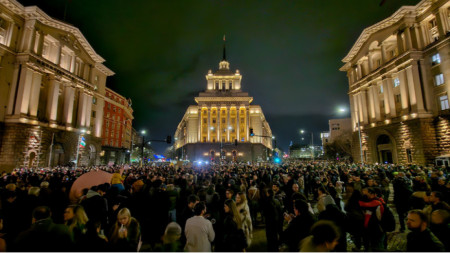
Minutes before the second and final reading, at the parliamentary budget and finance committee, of the state budget for 2026, the leader of the biggest party represented in parliament GERB Boyko Borissov halted the procedure and sent the draft bill..




 Rain
Rain Scattered showers
 Cloudy
 Snow
Snow Rain / Snow
 Clear
Clear