“Inequality between the strong and the fair sex is not a perfunctory phenomenon that can be corrected. We know thousands of jokes which feature two protagonists – the secretary and the boss. And we all laugh at them the way Americans laugh at “yo momma” jokes…” The feminist 1970s saying “Give us half the world, take half the house” has lost none of its poignancy today. Gender equality laws mitigate this state of affairs and to some extent punish open discrimination, yet they cannot give a permanent solution to prejudice against women,” says sociologist Evelina Slavkova for Radio Bulgaria.
 “Regrettably, this is something we see in Bulgaria, but also in the EU,” Evelina Slavkova says. “It is precisely for this reason that three years ago the European Commission launched a discussion on introducing quotas for women. The ambition is to have 40 percent of decision-making positions in the EU – i.e. women in managerial positions in public companies - earmarked for women by 2020. Significantly, Bulgaria, alongside Great Britain and the Netherlands took a stand against such quotas. I would like to firmly state that jokes about “women quotas” must stop and we must realize that people occupying top positions should be selected for their abilities and not their gender. Nonetheless, the proposal to introduce quotas for women is only logical as an attempt to narrow the enormous gulf between men and women at work. At the beginning of the year German parliament approved the introduction of a 30 percent quota for women on the boards of major companies. Quotas have been successfully introduced in France, Spain, Belgium, Slovenia, Portugal and Poland.”
Things have been changing in Bulgaria, without any quotas. According to latest data, 73 percent of people working in the civil administration, 30 percent of municipal councilors, and 11 percent of mayors are women. In Bulgaria the word “sexism” is not in the 1990 Bulgarian language dictionary; we now use the term “gender discrimination” - indicate the results of a Bulgarian Gender Research Foundation report on age discrimination or ageism. According to the report, ageism on the labour market now affects women at a younger age – 40-45. From that age on it is added to other stereotypes like looks and whether the applicant is suitable for the job. According to Evelina Slavkova, another big problem of inequality is pay and this is a structural problem – it is determined by gender stereotypes, by discrimination in the systems of work assessment and payment and gender segregation on the marker of labour. Even when they have the same level of education women do not get the same professional acknowledgement as men. A number of studies indicate that the average salary of women is below that of men.
“The average salary of women in Bulgaria is 20 percent lower than that of men. In the EU, this percentage is 16, even when the level of education and the professional start are the same. 83 percent of women in the EU have at least a secondary education; with men this percentage is 77.6. Yet, the share of women working part-time in the EU countries is thrice the number of men. And this has a negative effect on career development, on their unemployment benefits, retirement pensions etc. It is a sobering thought that families in which the bread-earners are women are considerably poorer.”
Women are frequently regarded as a “high-risk investment”, as at any given time they may ask for maternity leave, posing a potential threat to the work team. The conventional view of woman’s role as mother and wife is still very much alive. The requirements of the modern market rarely show consideration for the requirements of family, marriage or parenthood. When women marry, this is often seen as assuming responsibility for the family and giving up professional or career development.
English version: Milena Daynova

The Bulgarian minority in Romania marked a significant event with the official opening of the Bulgarian Inn in the village of Izvoarele (Hanul Bilgarilor), Teleorman County (Southern Romania)- a locality with Bulgarian roots dating back over 200 years...

The 14th edition of DiVino.Taste, Bulgaria’s leading forum for wines and winemakers, will take place from 28 to 30 November at the Inter Expo Centre in Sofia. Over 80 producers from all wine regions will participate, offering tastings of around 600 of the..
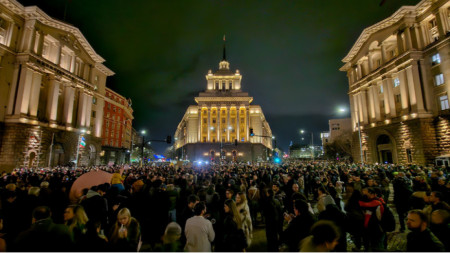
Minutes before the second and final reading, at the parliamentary budget and finance committee, of the state budget for 2026, the leader of the biggest party represented in parliament GERB Boyko Borissov halted the procedure and sent the draft bill..






 Cloudy
 Mostly Cloudy