Nowadays it is hard to realize the vast extent to which our daily lives are affected by science and technology. Therefore, a new discipline called "Science Communication" has set a goal to tell people about the progress of civilization in an interesting and simple way. Scientists have started to promote their activities using plain language. It is exactly the „translation" of scientific language into plain language where Nevena Hristozova sees her future. She is a PhD student in biology at a university in Belgium and she dreams about using her knowledge in Bulgaria.
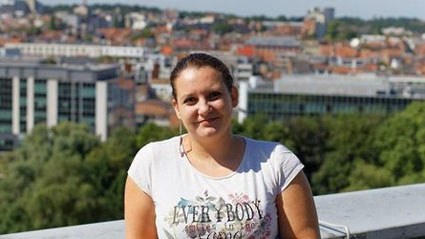 “Today, anyone can check everything on the Internet. And if you look for ‘headache’ you would probably read that you have a brain tumour. Having read the wrong information, many people have the impression that something irrelevant to their problem would help them and thus remain undiagnosed and untreated. There are also cases when information that was taken out of context is used to produce a grand conspiracy that evokes fear of science and technology. Some people think that mad scientists create monsters and cataclysms in their laboratories.”
That is why the more accessible language scientists use, the less people trust deceiving websites, manipulated information and myths.
“The most dangerous are the anti-vaccination movement and pseudo clinic studies claiming that a simple product has almost magical properties,” Nevena Hristozova says. “Misuse of antibiotics is also a big problem, because if bacteria develop resistance to the drug, you are harming not only yourself but also others. Generally there are all kinds of theories, but when they affect human health then this is a very serious problem that must be addressed.”
And "monster" GMOs stand first among these problems.
“Genetically modified foods go through numerous studies, including for toxicity allergenic qualities and whatnot. This cannot be said about any other food ingredient on the market, regardless of their origin. I work in the sphere of biotechnology and I can boldly say that genetically modified foods are not dangerous. In scientific circles there are many publications that prove that they are edible, as they are strictly controlled.”
It is not the same with food produced using radiation or chemical mutagenesis as the European legislation does not require special testing. Therefore, these products are on the market, although they could be dangerous both for human health and the environment, Nevena Hristozova says and adds:
“They are grown everywhere and we are talking about varieties that are present on our market, too. The grapefruit, for example is a hybrid that emerged centuries ago, but was never tested to see if radiation in the environment caused mutations at genetic level. There are many leguminous plants that are modified by chemical agents that change the structure of DNA. After being treated with these agents, they should be well cleaned, especially when it comes to seeds, but whether this is done is not clear.”
In such cases, the only thing that can be done is publishing reliable facts so people can make an informed choice about the food they consume.
English: Alexander Markov
Photo: courtesy of: Nevena Hristozova
Bulgaria celebrates National Reading Day on the third Friday of November. The Reading Foundation is leading the initiative under the motto: “Read. For Real”. According to the OECD's PISA 2022 study, 53% of 15-year-old students in Bulgaria have..
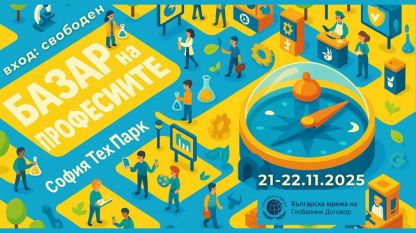
On November 21–22, 2025, the 11th edition of the Career Fair will take place at the John Atanasov Hall in Sofia Tech Park. The forum aims to support early career orientation for young people in Bulgaria and is organized by the Bulgarian Global..
From fear and doubts to joy and support – Bulgarians react differently to the upcoming introduction of the euro on January 1, 2026. For some, it is a logical step towards Bulgaria’s integration into the EU with promises of stability..








 Mostly Cloudy
 Fog
Fog Partly Cloudy
 Cloudy