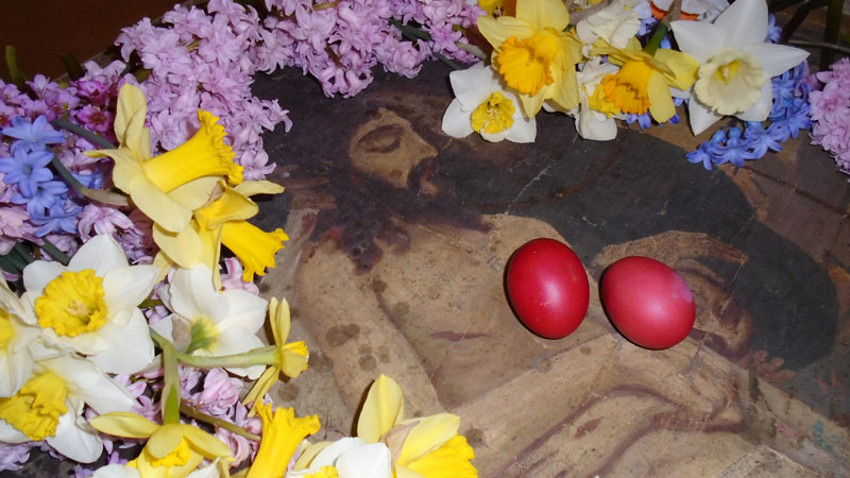
On this day, the church calls upon believers to recall of the Savior's voluntary sacrifice and His all-forgiving love. To feel the suffering of others because every pain reminds of the crucifixion of Christ. And just like a person suffering the most severe torment forgets to eat and even drink water, on Good Friday, believers do not have food or water.
In this way, they express their compassion for the suffering and relate to the crucifixion of the Savior. In the morning of Good Friday, before the service, a high table covered with the Epitaphios (Plashtanitsa) is placed in the middle of the church, symbolizing the tomb of Christ. The Gospel, the Cross and white flowers are placed on it. After the service, Orthodox Christians proceed to the symbolic tomb of Christ, to bow to the image of the Savior embroidered on the cloth, to kiss it, and then kiss the Gospel and the Cross. They also lay flowers and crawl under the table. Then they bow before the big Cross in the church and before the icons of the Holy Virgin Mary and St. John the Evangelist, and after kissing them, humbly leave the temple.
This year, the Holy Synod of the Bulgarian Orthodox Church has called on believers not to kiss or touch the Plashtanitsa, not to crawl under it, nor lay flowers and geranium, but to make the sign of the cross and a deep bow.
Editor: Darina Grigorova
English: Alexander Markov
Photo: archive
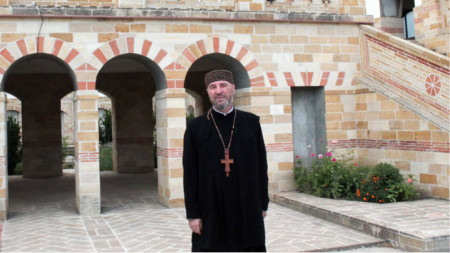
Father Genadiy Martinov is a Bessarabian Bulgarian, born in the village of Devetliy, Odessa province (Ukraine). Two centuries ago, his family lived in Eastern Thrace, near Edirne, but after the end of the Russo-Turkish War (1828–1829), during a period..
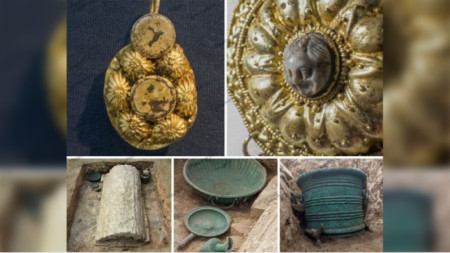
An intact grave of a young woman dating to the beginning of the 2nd century AD has been discovered by archaeologists near the village of Kapitan Petko Voivoda, Topolovgrad Municipality announced. The team that made the discovery is led by Daniela Agre..
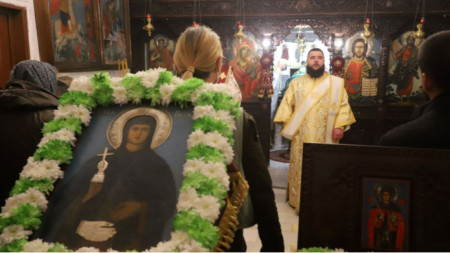
On October 14, the Bulgarian Orthodox church pays homage to Saint Paraskeva, also called St. Petka of Tarnovo and the day is known in Bulgaria as "Petkovden". Saint Petka was born in the 11th century in the town of Epibat, on the Sea of..







 Rain
Rain Mostly Cloudy
 Cloudy
 Overcast, rain
 Scattered showers